
Keywords
lion dollar
akce
silver
Netherlands
Ottoman Empire
Leskovac
trade
Abstract
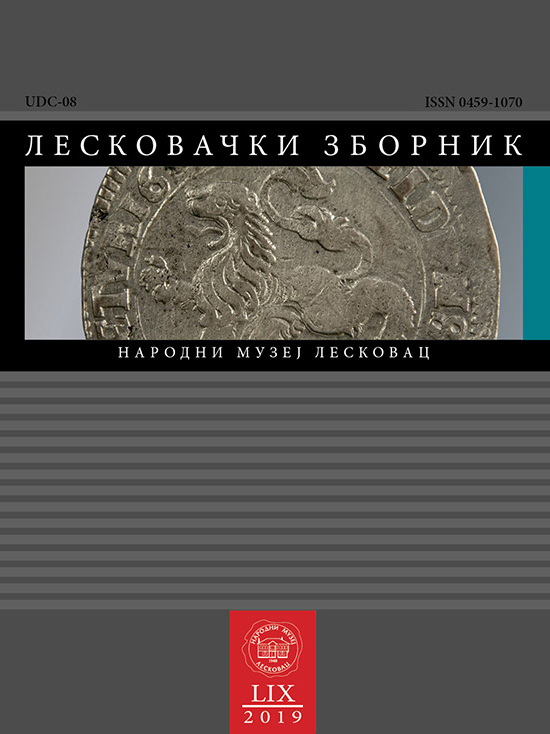
Numismatic collection of Leskovac museum holds seven pieces of United Dutch provinces currency, Lion thalers, better known as Lion dollars. Unfortunately we don’t hold any accounts for acquisition of these coins. Lion thaler was first coined in 1575 during the struggle for independence of Dutch provinces from Spain. Lion dollar were issued by six Dutch provinces, along with independent issues produced by some major Dutch towns. Lion dollar was lighter than larger denomination coins then in circulation, so clearly it was more advantageous for a merchant to pay foreign debt in lion dollars and this became the coin of choice for foreign trade. Lion dollars of Dutch provinces were extensively used in the developing trade of the Dutch provinces with Ottoman empire starting at the end of the 16th century before official relations even existed between Dutch provinces and Ottoman empire. During second half of 16th century Ottoman Empire experienced economical difficulties that were followed by debasement of ottoman silver coin, akca. During debasement of 1586 akca lost 44% of its silver content, and this continued up to 1640 when akca declined to 0.3 grams. It thus became very difficult to handle, and large number of akces were needed even for small, daily transactions. During this time greater demand emerged for the more stable European coinage, especially the well- known large silver thalers, among them The Dutch lion dollars. After 1620 large quantities of lion dollars were minted nearly exclusively for export to the Ottoman Empire where they were introduced in widespread circulation. During 17th century Leskovac was well established local economical and trading center in Ottoman Empire, well known for its fair. Presence of large number of traders from all corners of Ottoman empire, Dubrovnik, and west Europe, visiting and trading in Leskovac fair, would explain presence of Lion dollars in this area and thus probably in Leskovac museum.

This work is licensed under a Creative Commons Attribution-NonCommercial-NoDerivatives 4.0 International License.